

Chopin’s Waltz in A-flat Major, Op. 42: When the Ballroom Discovers Red Bull

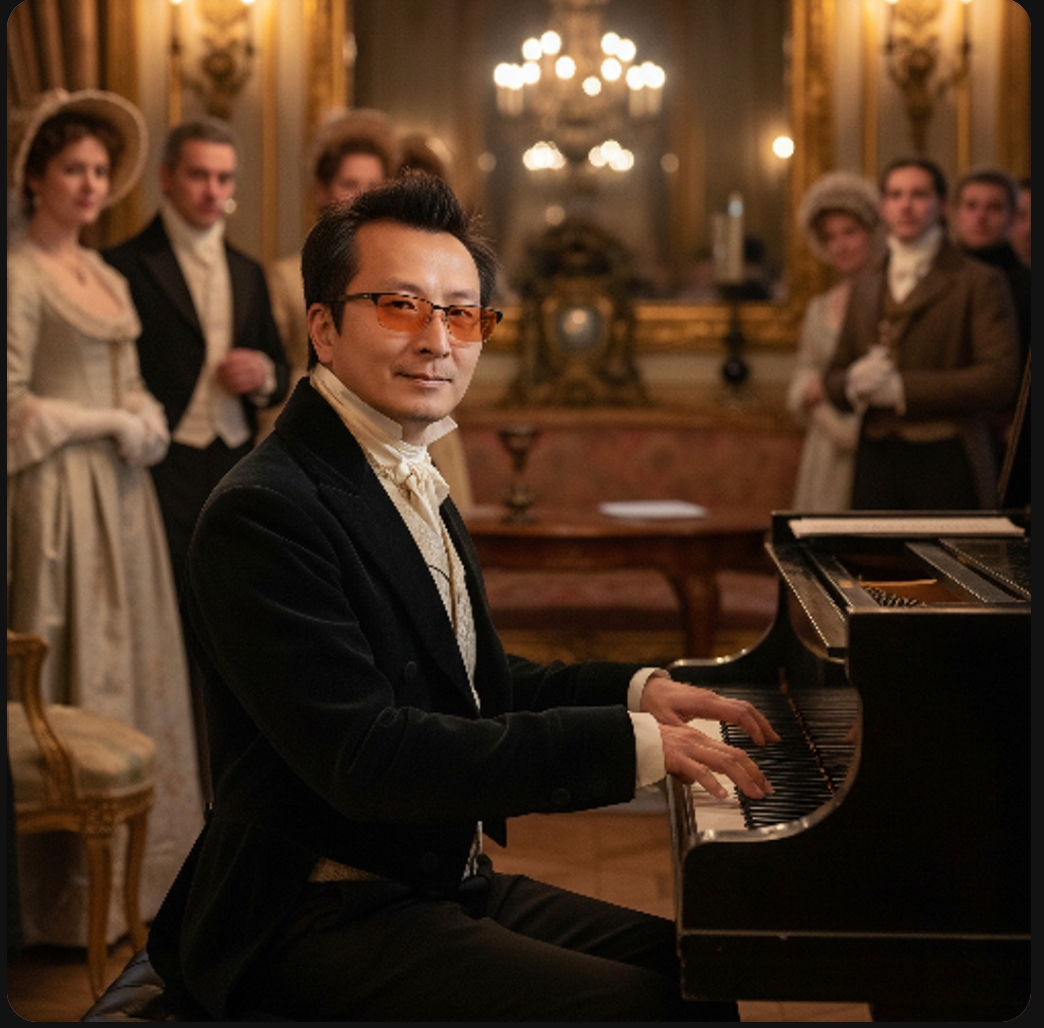
Chopin once called this his “waltz supreme.” Personally, I think of it as the moment when a polite ballroom suddenly discovers Red Bull.
Parisian Sparkle Meets Mathematical Chaos
On the surface, it’s all Parisian sparkle — chandeliers, swirling gowns, aristocratic charm. The Waltz in A-flat Major, Op. 42, composed in 1840, has everything you’d expect from a Chopin waltz: elegant melodic lines, sophisticated harmonies, and that unmistakable scent of Parisian salon culture where Countess d’Appony and her fashionable friends would have first heard it.
But listen closely and Chopin is playing tricks.
The Polyrhythmic Puzzle
The left hand insists on three while the right hand swears it’s in two. It’s like dancers moving in two dimensions at once… or like me trying to dance while holding a glass of champagne.
This isn’t a performance mistake or interpretive liberty — it’s written into the DNA of the piece. Chopin creates what musicians call “hemiola”: a rhythmic device where two conflicting metric patterns coexist. While your left hand maintains the quintessential “ONE-two-three, ONE-two-three” waltz pattern, your right hand often phrases in groups of two, creating a subtle push-and-pull that makes the music feel simultaneously grounded and airborne.
It’s the musical equivalent of standing still while the room spins around you — or perhaps more accurately, spinning so perfectly that the room appears still.
Why “Supreme”?
When Chopin called this his “waltz supreme,” he wasn’t just being dramatic (though let’s be honest, he was always a bit dramatic). He was acknowledging something he’d achieved here that eluded him in earlier waltzes: perfect balance.
This waltz is neither purely concert material nor simple salon entertainment. It’s virtuosic without being ostentatious. It’s technically demanding yet sounds effortless. It has the intimacy of chamber music and the sweep of orchestral writing. The left hand becomes more than accompaniment — it’s a partner in conversation, sometimes leading, sometimes following, always essential.
Most importantly, it captures the essence of aristocratic European dance culture while simultaneously deconstructing it. Chopin takes the waltz — that symbol of order, elegance, and social grace — and introduces just enough rhythmic ambiguity to make us question whether we’re watching the dance or being danced by something larger.
The Physical Experience
From a performer’s perspective, this piece is a delightful workout in controlled chaos. Your body has to commit fully to two competing rhythmic realities. Your left hand lives in waltz time, grounded and circular. Your right hand phrases across the bar lines, linear and propulsive.
The pedal becomes crucial — not just for blending harmonies but for creating that characteristic Chopin shimmer where everything bleeds together just enough to sound luxurious but not muddy. You’re painting with sustain and release, creating the sonic equivalent of light refracting through crystal.
And then there are the moments where Chopin suddenly strips everything down to a single melodic line, as if the entire ballroom pauses to listen to one person’s whispered secret before erupting again into full celebration.
Time in Motion
Give it a spin — and if you feel dizzy by the end, congratulations, you’ve just waltzed with time itself.
There’s something fundamentally disorienting about this waltz, and I mean that in the best possible way. It does to your sense of rhythm what an Escher painting does to your sense of perspective: you can see the logic, follow the pattern, and still feel like you’re walking on walls.
This is Chopin the architect, building musical spaces with impossible geometry. This is Chopin the poet, making you feel nostalgia for a moment you’re currently experiencing. This is Chopin the quantum physicist (a century before quantum physics), demonstrating that particles of sound can exist in two states simultaneously.
When you listen — really listen — you’ll notice that the piece never quite resolves its rhythmic tension. It doesn’t need to. The tension is the point. Life doesn’t move in perfect threes or neat twos. It syncopates. It interrupts itself. It dances to multiple rhythms at once, and somehow, miraculously, it works.
An Invitation to Spin
I invite you to experience this recording not just as a listener but as a dancer. Let your body respond. Notice which rhythmic layer you gravitate toward. See if you can feel both simultaneously — the grounded waltz and the soaring melody, the structure and the freedom, the earth and the sky.
And if you find yourself slightly off-balance by the final chord, don’t worry. That’s not a bug in your listening; it’s a feature of the composition.
After all, the best waltzes don’t just move your feet. They move your sense of what’s possible.
#Chopin#Waltz #Op42 #PianoMasterpiece #DancePoem #ParisianElegance #CountessWaltz #TimeInMotion #QuantumWaltz #PianoLovers #ConcertLife #ClassicalVibesB
