The Long Work of Building a Music School That Lasts
Twenty years of grant writing, faculty mentoring, summer residencies, and quietly keeping the lights on — and what it taught me about the kind of leadership a mission-driven music school actually needs.

Twenty years of grant writing, faculty mentoring, summer residencies, and quietly keeping the lights on — and what it taught me about the kind of leadership a music institution actually needs.
Most pianists of my generation grew up assuming the institutions that shaped us — conservatories, community schools, summer academies, festivals tucked into small towns and old estates — would always be there. They had been there for our teachers, after all, and for theirs. The buildings were old, the pianos were older, and the rooms still smelled the way rooms in music schools smell: a little dusty, a little woody, faintly of rosin from the studio down the hall.
Then a great many of those institutions started to disappear.
I have spent the last twenty years working at the intersection of classical music and institutional leadership, and one thing I can say with certainty is that the mission-driven music school is among the most fragile organizational forms in cultural life. It depends on a delicate alignment of factors — committed faculty, generous donors, healthy enrollment, sound facilities, a board that understands what a music school actually does. Lose any one of those for too long and the rest can unwind quickly. I have watched it happen. I have also helped build it back.
I want to write here not about piano playing — I write about that elsewhere — but about the quieter, harder work of leading, and sometimes rescuing, a music school. Because I think this work is not well understood. People who come to it from a purely business background tend to miss what makes it work. People who come to it from a purely artistic background often miss what keeps it alive. The job lives in the seam between the two, and the seam is where I have spent most of my career.
The myth of the steady-state music school
There is no such thing as a music school running on autopilot.
The schools that look stable from the outside are almost always the ones whose leadership is doing an enormous amount of unglamorous work behind the scenes: stewarding donors, courting grant officers, sweating over registration software, calling families one at a time during enrollment season, running a tighter facilities operation than the average small business. When those schools later wobble — usually after a quiet leadership transition or a cultural disruption like the COVID years — the wobble does not feel sudden to anyone who has been paying close attention. The infrastructure simply caught up with the inattention.
The schools I have helped lead have all, at one point or another, been in this kind of moment. A community music school I co-led for two and a half years had emerged from the pandemic with depleted enrollment, weakened donor relationships, outdated administrative systems, and a community that needed to be reminded the school existed and was worth supporting. We rebuilt enrollment to over two hundred active students, hired and mentored more than thirty faculty members, generated more than three hundred thousand dollars in revenue through grants, donor cultivation, and new programming, and modernized the back-office systems to save tens of thousands of dollars a year. The school was named “Best Music School” in its city in early 2026, with a 4.9-star community rating across nearly a hundred reviews.
I tell that story not as a victory lap but because the lesson inside it is the one I keep coming back to: a music school’s recovery is never a single brilliant move. It is the patient, simultaneous work of repairing every load-bearing beam at once.
Money is the means, not the mission — but the mission dies without it
I have heard arts leaders say, in various ways, that they did not get into this work to chase money. I understand the sentiment, but I do not entirely agree with it, and I think the sentiment is partly responsible for why so many beautiful institutions struggle.
Revenue is not the point of a music school. But revenue is what allows the point of a music school to continue existing. An executive director who cannot generate revenue — through grants, through individual giving, through new programming, through partnerships, through the resourceful monetization of underused assets — is not protecting the mission. They are slowly liquidating it.
In my own work I have written grants to the Arts Council of Ireland, Fáilte Ireland, and a long list of regional foundations in the United States. I have built donor programs from scratch, including the kind of gala partnership with a major symphony that raises six figures in a single evening. I have launched satellite programs that brought music instruction into school districts that did not previously have access to it — programs that did important community work and gave the school a visible impact story that funders responded to. I founded and ran an international summer piano festival in Dublin for five consecutive years, which meant building a multi-week residential program from concept through execution, including faculty contracts, venue agreements, marketing across multiple countries, and the operational discipline to do the whole thing again the following year without losing momentum.
That work taught me something about the relationship between vision and execution. A vision without execution is decoration. An execution without vision is busywork. The job is to hold both — and to make sure the institution’s resources are being aligned, every quarter, toward measurable outcomes the board, the faculty, and the donors can all recognize.
Faculty are the institution
A music school is not a building, a brand, or even a curriculum. It is a faculty.
I have hired, supervised, and mentored more than thirty teaching artists across two countries, and I have come to believe that the most consequential decisions a music-school leader makes are personnel decisions. Who you bring in. How you onboard them. How you support their growth. And — the part nobody likes — how you part ways with people whose work, whatever its other merits, no longer aligns with where the institution needs to go.
The professional development program I built at my most recent school, Faculty Connect, was an attempt to take faculty support seriously as an organizational discipline. It improved retention. It improved teaching quality. It made faculty feel that the school was investing in them, which made them more willing to invest in the school in return. None of this was complicated. It was simply a matter of treating teachers as professionals whose careers mattered, and being honest with them about expectations.
The harder side of the same equation is accountability. A leader who cannot make difficult personnel decisions when the work calls for it is not, in the end, leading anything. Faculty notice. Students notice. Donors eventually notice too.
The discipline of the summer
Some of the most meaningful work I have done has happened in residential summer programs — students living on a campus for weeks at a time, faculty in close daily contact with them, concerts and masterclasses scheduled around morning practice and shared meals. There is a particular intensity to a residential program that an academic-year school cannot replicate. You are not running a series of lessons. You are running a small temporary society.
That work requires a leader who is genuinely willing to be present. Not just administratively present — physically present, on site, sleeping in the same housing the students sleep in, eating in the same dining hall, walking the grounds at the end of the day to make sure the practice cabins are locked and the pianos are tuned and the staff has what they need for tomorrow. Programs of this kind succeed or fail on operational detail, and the detail cannot be managed entirely from a laptop on the other side of the country.
Off-season work matters just as much. Faculty contracts must be issued in time. Adjudications must be run cleanly. Marketing has to be in market early enough to fill the program. Registration and payment systems must work — actually work, the way a parent in another country expects them to work at midnight on a Saturday. The off-season is when a residential program is invisibly built. The summer is when it is performed.
The systems behind the music
I want to say something here about software, because in arts leadership conversations it is often dismissed as a back-office concern. It is not.
A music school’s CRM, registration platform, billing system, scheduling tool, and donor database are the institution’s nervous system. If they are clean, the leader can see what is happening across the school in close to real time and act on it. If they are not, the leader is flying blind, and so is everyone else. Modernizing the administrative stack at my most recent school — replacing legacy tools with online registration, integrated scheduling, and automated billing — saved more than twenty-five thousand dollars a year and, more importantly, freed faculty and staff to spend their attention on students rather than paperwork. I am proficient with RegPack-style registration platforms, with Google Workspace top to bottom, with the major CRM systems used by small arts nonprofits, and with the kind of basic web and audio/video production work that lets a school tell its own story without depending on outside agencies.
These are not glamorous skills. They are the difference between an institution that runs and one that drags.
The artist and the operator
The deepest reason I am drawn to leading music schools is that I believe the work matters — and I believe it is harder than most people realize to lead this kind of institution well. It requires someone who can sit with a major donor at lunch, debug a registration form an hour later, sit in on a faculty review in the afternoon, write a grant narrative that evening, and walk out the next morning to give a masterclass. The kind of leader these institutions need is not a generalist who happens to like music, and not a musician who tolerates administration. It is someone for whom the two things are continuous — for whom the operational decisions are artistic decisions, because they shape the conditions under which the music gets made.
That is the work I have been doing my whole career. Founding a festival, sustaining a school through an economic recession, rebuilding a community institution after a pandemic, mentoring a faculty, raising money, modernizing systems, and never losing track of why any of it is happening: because somewhere on that campus, every day, a pianist is sitting down at an instrument and trying to do something true.
The institutions that survive the next decade will be the ones led by people who understand both halves of that sentence.
I have spent twenty years preparing to be one of them.
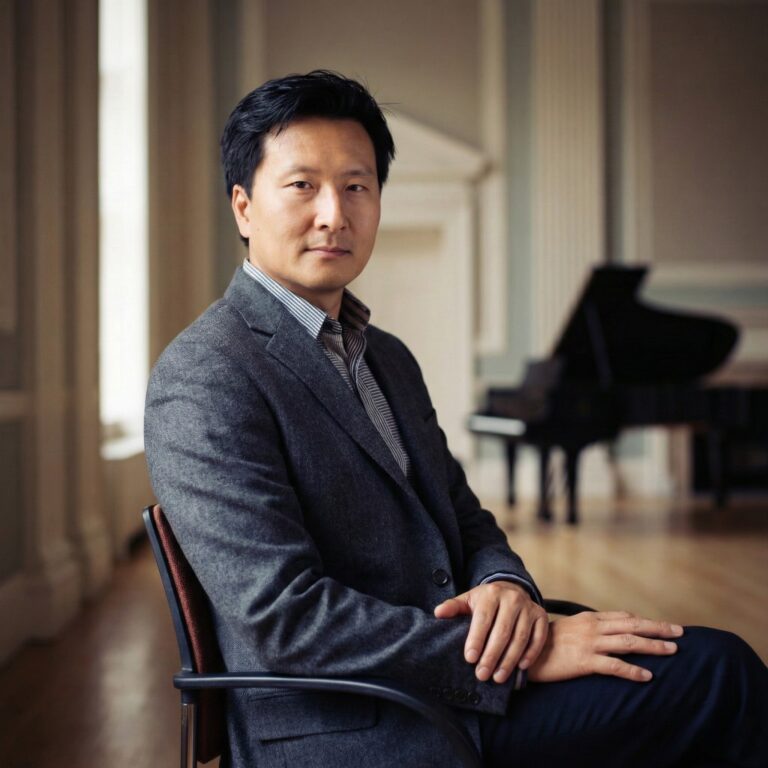
Dr. Archie Chen is a pianist, music educator, and arts executive based in Spokane, Washington. He has performed at Carnegie Hall, Lincoln Center, Gewandhaus Leipzig, and the National Concert Hall of Ireland; recorded for Sony Classical and Carnegie Artists Records; and spent two decades founding, leading, and revitalizing music institutions in the United States and Europe. He holds a Doctor of Music in Piano Performance from the Royal Irish Academy of Music / Dublin City University.